
Pulse Diagnosis as a Dynamic, Ongoing Evaluation
Introduction: Why Assessment Cannot Be a One-Time Event
In many medical settings, diagnosis is treated as a fixed conclusion: once a condition is identified, treatment proceeds according to a predetermined plan. In clinical Chinese medicine, assessment is understood differently. Because the human body is a living, adaptive system, its internal state is constantly changing.
For this reason, pulse diagnosis is not performed once and then set aside. It functions as a dynamic, ongoing evaluation, guiding treatment decisions at every stage of care.
The Body as a Continuously Changing System
Physiological regulation is never static. Even within the same individual, internal conditions shift from day to day—or even hour to hour—depending on factors such as:
- Stress and emotional state
- Sleep quality and fatigue
- Digestion and nutrition
- Environmental and seasonal changes
- Response to previous treatment
A treatment strategy that was appropriate last week may require adjustment today. Pulse diagnosis allows clinicians to recognize these shifts directly, rather than relying on assumptions based on past findings.
Pulse Changes Reflect Real-Time Regulation
The pulse responds quickly to changes in internal regulation. After treatment, it may show signs of improved coordination, reduced tension, or greater stability. In other cases, it may reveal areas where the system is still compensating or struggling to adapt.
This responsiveness makes pulse diagnosis an effective feedback mechanism. It helps answer practical clinical questions such as:
- Is the treatment supporting regulation or creating strain?
- Has the system stabilized enough to reduce intervention?
- Are new imbalances emerging as old ones resolve?
Rather than chasing symptoms, the clinician follows the body’s regulatory response.
Why Treatment Must Adjust Over Time
In Chinese medicine, treatment is not designed to impose a fixed outcome, but to support the body’s own capacity to regulate. As this capacity changes, treatment must change with it.
Pulse diagnosis provides the information needed to make these adjustments responsibly. It helps prevent:
- Over-treatment when the system no longer needs stimulation
- Under-treatment when regulation remains insufficient
- Rigid protocols that fail to respond to individual variation
This adaptability is especially important in chronic or complex conditions, where progress often occurs in stages rather than linear resolution.
Beyond Symptom Improvement
Symptom relief is meaningful, but it does not always reflect full systemic recovery. Symptoms may diminish while regulatory patterns remain unstable—or shift in ways that require continued support.
Pulse diagnosis allows clinicians to distinguish between temporary improvement and true physiological stabilization. It helps determine when care should continue, change direction, or transition toward consolidation and maintenance.
Continuous Evaluation as Clinical Responsibility
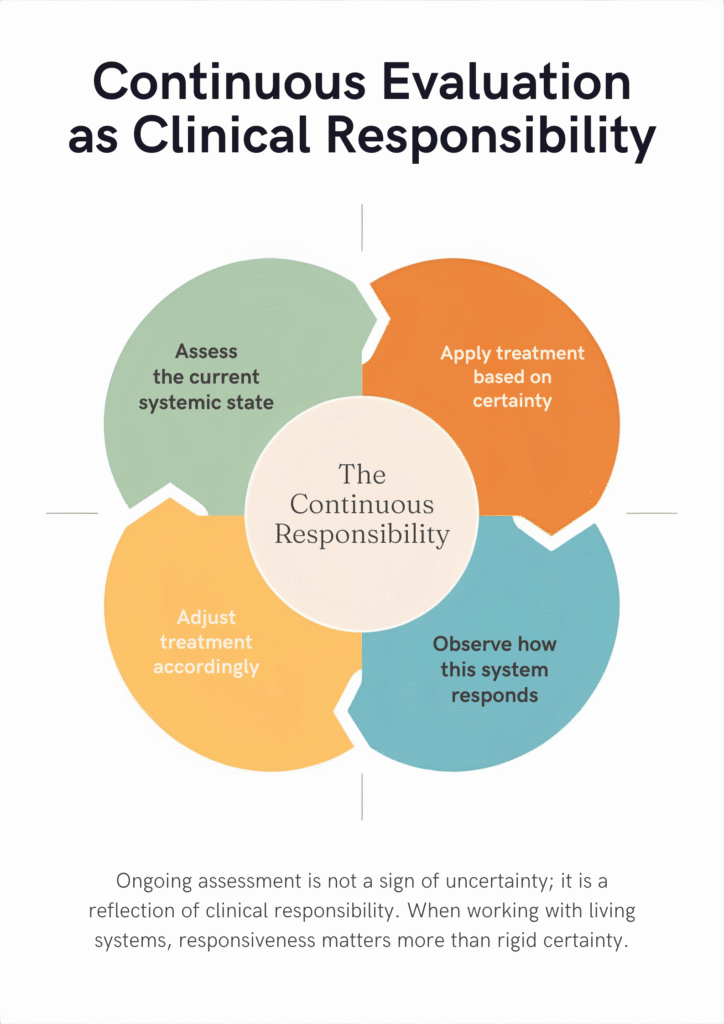
Ongoing assessment is not a sign of uncertainty; it is a reflection of clinical responsibility. When working with complex living systems, responsiveness matters more than rigid certainty.
Pulse diagnosis supports a continuous evaluation loop:
- Assess the current systemic state
- Apply treatment based on that state
- Observe how the system responds
- Adjust accordingly
This loop allows care to remain precise, individualized, and outcome-oriented.
Relationship to Pulse Diagnosis as a Systems Method
As discussed in Why Pulse Diagnosis Is a Systems Assessment Method, the pulse reflects integrated physiological regulation rather than isolated indicators. Its dynamic nature makes it uniquely suited for repeated evaluation.
Each pulse reading is not a repetition of the last, but a new snapshot of system behavior at that moment in time.
Conclusion: Assessment That Evolves with the Patient
Pulse diagnosis functions not as a one-time diagnostic act, but as an evolving conversation with the body. By tracking changes in regulation over time, it allows treatment to remain aligned with the patient’s current condition rather than past assumptions.
This ongoing evaluation supports care that is flexible, responsive, and deeply individualized—qualities that are essential when working with complex, changing human systems.