
Yin–Yang in Chinese Medicine: A Regulatory Model for Balance and Change
Introduction: Why Yin–Yang Is Often Misunderstood
Yin–yang is one of the most widely recognized concepts associated with Chinese medicine—and also one of the most frequently misunderstood. It is often treated as a philosophical symbol, a cultural metaphor, or a vague idea of opposites. In clinical medicine, however, yin–yang functions as a practical regulatory model for understanding how physiological processes maintain balance, adapt to change, and become disordered.
Rather than describing substances or structures, yin–yang describes relationships, tendencies, and dynamics within living systems. It provides a way to observe how functions interact, compensate, and transform over time.
Yin–Yang as a Model of Regulation, Not Opposition
In Chinese medicine, yin and yang do not represent fixed opposing forces. They describe complementary aspects of the same system, each defined in relation to the other.
From a regulatory perspective:
- Yin refers to aspects that are relatively inward, nourishing, cooling, stabilizing, or structural.
- Yang refers to aspects that are relatively outward, activating, warming, mobilizing, or functional.
These are relative, not absolute descriptions. What is yin in one context may function as yang in another. The value of yin–yang lies not in categorization, but in observing how balance is dynamically maintained.
Dynamic Balance: Why Health Is Never Static
A core insight of Chinese medicine is that health is not a fixed equilibrium, but a continuous process of adjustment. Yin and yang are constantly interacting, rising and falling, transforming into one another in response to internal needs and external conditions.
This dynamic view explains why:
- Symptoms fluctuate rather than remain constant
- Conditions evolve over time
- The same diagnosis may present differently from day to day
From this perspective, illness arises not because yin or yang “disappears,” but because their relationship becomes poorly regulated—one aspect dominating, failing to support, or no longer transforming appropriately.
Yin–Yang and Physiological Function
In clinical observation, yin–yang relationships can be seen across multiple levels of physiology:
- Activity and rest
- Warmth and cooling
- Expansion and contraction
- Mobilization and consolidation
For example, excessive activation without adequate nourishment may manifest as agitation, insomnia, or inflammatory patterns. Conversely, excessive consolidation without sufficient activation may present as fatigue, coldness, or stagnation.
Yin–yang offers a language for describing these patterns without reducing them to isolated symptoms.
Temporal Rhythms: Day, Night, and Seasonal Change
Yin–yang is also a model for understanding time-based regulation. Chinese medicine observes that physiological functions follow predictable rhythms:
- Daytime activity corresponds to relatively yang phases
- Nighttime restoration corresponds to relatively yin phases
- Seasonal changes shift the overall balance of yin and yang
Disruption of these rhythms—through chronic stress, irregular schedules, or environmental mismatch—can strain regulatory capacity and contribute to illness. Yin–yang theory allows clinicians to recognize when treatment must support rest, recovery, and consolidation, rather than further stimulation.
Clinical Implications: Applying Yin–Yang in Practice
In clinical practice, yin–yang is not used as a label, but as a decision-making framework. It guides questions such as:
- Does this presentation reflect excess activity or insufficient support?
- Is regulation failing due to overactivation or undernourishment?
- Should treatment emphasize calming, warming, mobilizing, or stabilizing?
This approach helps explain why two patients with similar symptoms may require different treatments, and why the same patient may need different strategies at different stages of recovery.
Yin–yang does not dictate fixed protocols. It supports adaptive clinical reasoning.
Yin–Yang and Qi Regulation
Yin–yang is inseparable from qi. While qi describes functional activity and movement, yin–yang describes the polarity and balance of that activity.
Qi that is overly constrained, depleted, or excessive will express imbalanced yin–yang relationships. Conversely, restoring yin–yang balance supports smoother qi regulation. Together, these concepts form a cohesive model for understanding physiological coherence.
Beyond Dualism: Transformation Rather Than Conflict
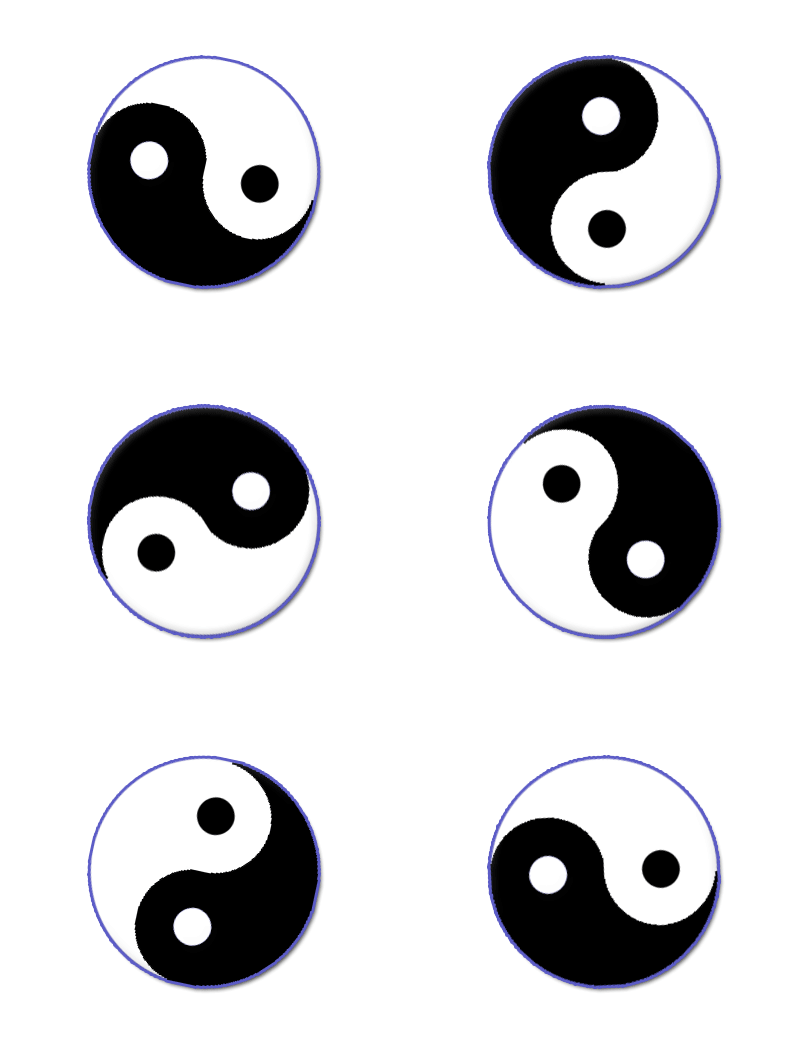
A common misconception is that yin and yang are in constant conflict. In Chinese medicine, the emphasis is instead on transformation. Yin gives rise to yang, yang returns to yin. Health depends on this capacity for orderly change.
Illness arises when transformation becomes impaired—when the system loses flexibility and responsiveness. Treatment aims not to suppress one side, but to restore the conditions under which transformation can occur.
Conclusion: Yin–Yang as Clinical Logic
Yin–yang is not a philosophical abstraction imposed on medicine. It is a clinical logic derived from observation—a way of understanding how living systems regulate, adapt, and recover.
By focusing on relationships rather than isolated variables, yin–yang provides Chinese medicine with a powerful framework for addressing complexity, change, and individual variation. It remains clinically relevant not because it is ancient, but because it describes patterns of regulation that modern medicine continues to explore.
This regulatory logic is further elaborated through the Five Phases model.