
Pulse Diagnosis: A Systems-Based Clinical Assessment Method

What Is Pulse Diagnosis?
Pulse diagnosis is a core clinical assessment method in Chinese medicine. Rather than focusing on isolated symptoms or disease labels, it evaluates the current state of systemic regulation—how the body’s internal processes are functioning, interacting, and adapting at a given moment.
By palpating the pulse at specific positions on the wrist, the clinician gains information about circulation, functional balance, tension, depth, rhythm, and overall coherence. These qualities reflect not a single organ or structure, but the integrated behavior of the body as a living system.
Pulse diagnosis serves as the primary interface through which internal regulation is assessed and treatment decisions are guided.
Why Pulse Diagnosis Matters
Symptoms describe what a person experiences. Pulse diagnosis helps explain why those symptoms arise.
Because many conditions involve overlapping systems and evolving patterns, symptom-based evaluation alone may not capture the full picture. Pulse diagnosis provides insight into underlying regulatory dynamics—revealing whether the body is constrained, overactivated, depleted, or struggling to adapt.
This systems-level perspective allows care to remain individualized and responsive, particularly in chronic, complex, or recurrent conditions.
For a deeper explanation, see: Why Pulse Diagnosis Is a Systems Assessment Method

Pulse Diagnosis as an Ongoing Evaluation
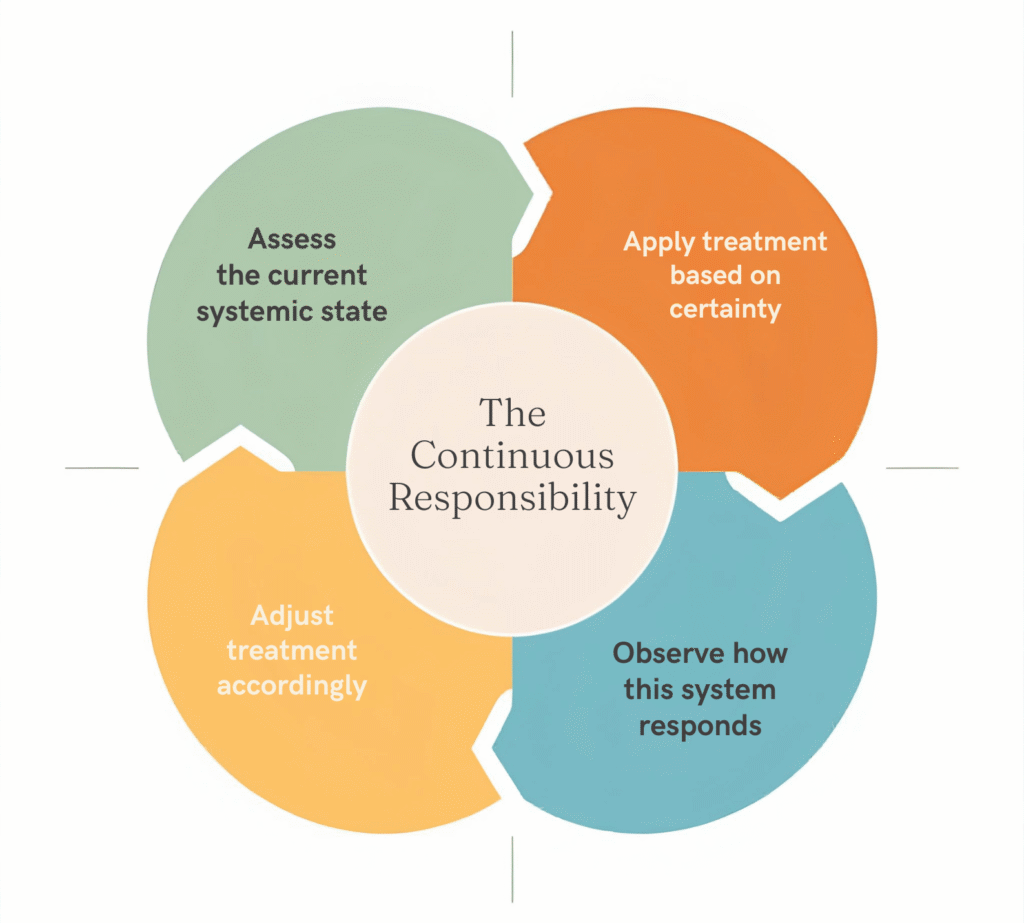
The human body is constantly changing. Internal regulation shifts with stress, sleep, digestion, environment, and prior treatment. For this reason, assessment in Chinese medicine is not a one-time event.
Pulse diagnosis functions as a dynamic, ongoing evaluation. Each visit provides updated information about how the system is responding, stabilizing, or requiring adjustment.
This continuous feedback allows treatment to evolve responsibly rather than follow rigid protocols.
Learn more: Pulse Diagnosis as a Dynamic, Ongoing Evaluation
Why Pulse Diagnosis Cannot Be Standardized
Pulse diagnosis is sometimes misunderstood as subjective because it does not rely on fixed numerical values. In reality, it assesses context-dependent system behavior, which cannot be fully captured through rigid standardization.
Qualities such as coordination, adaptability, and balance are emergent properties of living systems. Attempting to reduce them to static metrics risks losing meaningful clinical information.
Pulse diagnosis relies on structured pattern recognition developed through disciplined observation and outcome-based refinement.
Read more: Why Pulse Diagnosis Cannot Be Standardized

Pulse Diagnosis vs Symptom-Based Evaluation
Symptom-based evaluation plays an important role in healthcare, especially for identifying acute or clearly defined conditions. However, symptoms are often secondary expressions of deeper imbalance.
Pulse diagnosis complements symptom evaluation by assessing the internal regulatory state that gives rise to symptoms. This explains why similar symptoms may require different treatments, and why different symptoms may share a common underlying pattern.
Explore the difference: Pulse Diagnosis vs Symptom-Based Evaluation
What Pulse Changes Reveal Over Time
Healing is a process, not a single event. While a single pulse reading offers a snapshot of current regulation, changes in the pulse over time reveal the trajectory of recovery.
Pulse changes may appear before symptoms improve, or persist after symptoms resolve. Tracking these changes helps determine whether recovery is superficial or supported by genuine systemic stabilization.
This time-based perspective supports long-term outcomes and relapse prevention.
Learn how progress is evaluated: What Pulse Changes Tell Us Over Time

How Pulse Diagnosis Guides Our Clinical Approach
Pulse diagnosis is not used in isolation. It serves as the central assessment method guiding our clinical reasoning, treatment selection, and ongoing adjustment.
By continuously evaluating systemic regulation, we tailor care to the patient’s current condition rather than relying on fixed protocols or static diagnoses.
See how this fits into care:
Pulse Diagnosis as Clinical Intelligence
Pulse diagnosis represents a form of clinical intelligence grounded in observation, pattern recognition, and responsiveness to change. It does not replace modern diagnostic tools, nor does it compete with symptom-based evaluation. Instead, it adds a systems-level perspective essential for individualized, adaptive care.
By focusing on regulation, balance, and transformation over time, pulse diagnosis remains a clinically relevant and powerful method for understanding health in complex living systems.
Schedule a Consultation Focused on Accurate Diagnosis
If you are seeking care guided by precise diagnostic assessment rather than generalized protocols, we invite you to schedule a consultation at ANAWC.